This is Seena Labs
Start with what your users need you to know.
Hello, world.
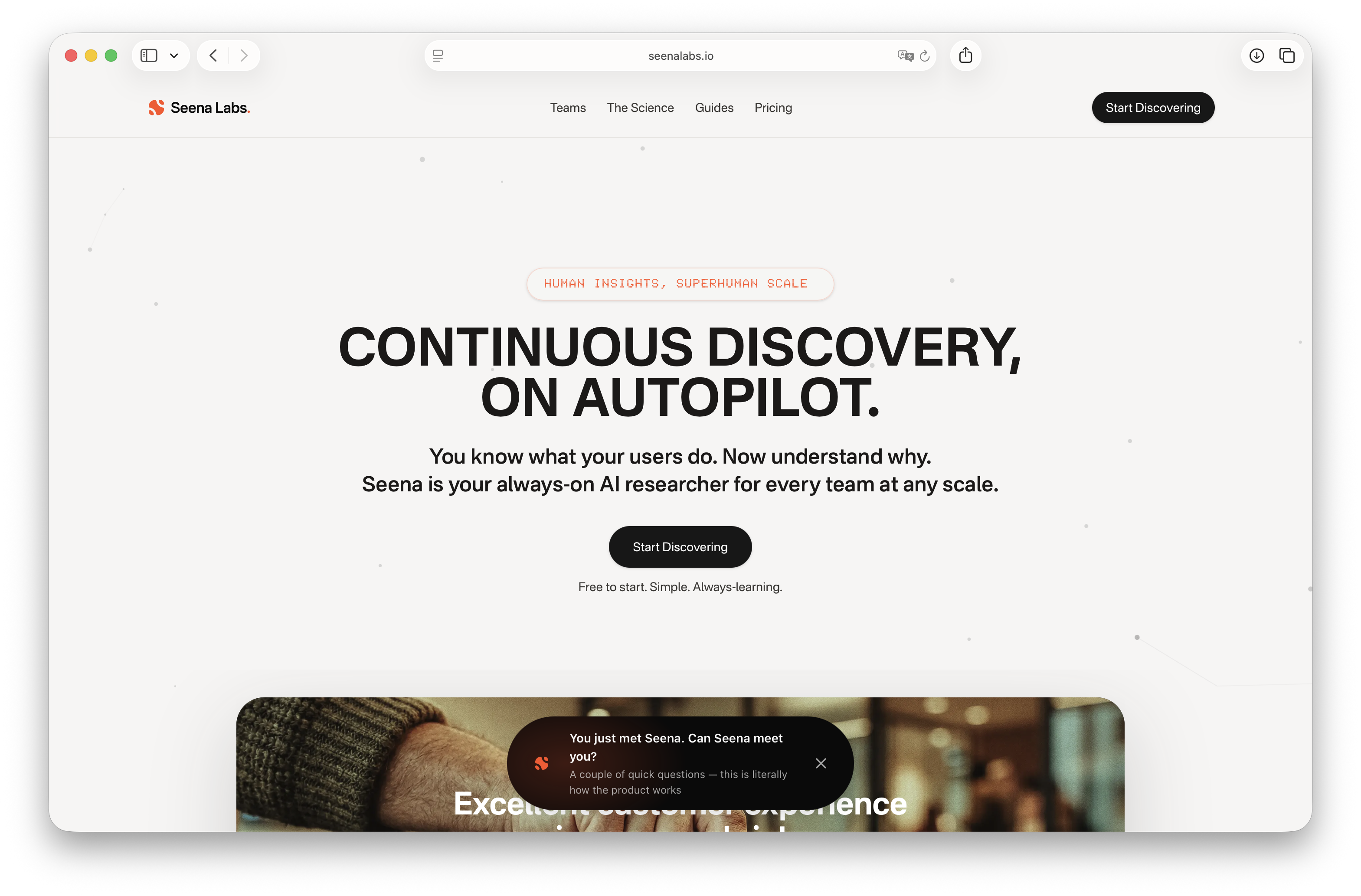
Today, Seena Labs is introducing an always-on understanding layer for product teams. That same line of script tracks the full behavioral layer: every session, every path, every point of friction.
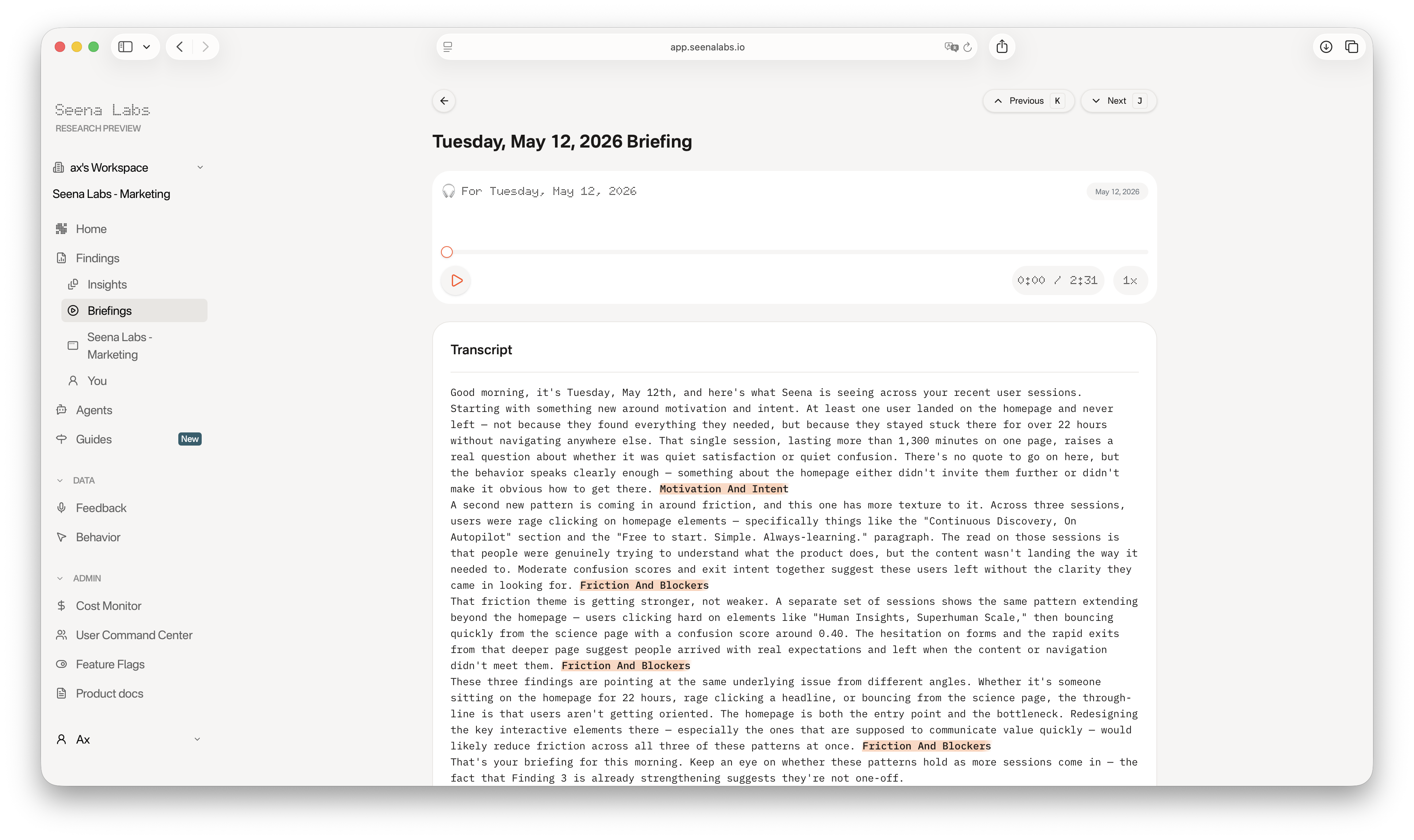
Most tools hand you a dashboard and ask you to figure it out. Seena hands you the brief — what your users did yesterday, what they said about it, what it means — in the first three minutes of your morning, before you've decided what to look for.
That's the flip. We're starting product work with the answer, not the homework.
Here's the problem.
Shipping has never been faster. AI-assisted development has compressed the gap between idea and deployed code from weeks to days.
Understanding has not.
Product managers still piece it together by hand. Analytics in one tab. Interview notes in another. Support tickets, transcripts, repositories, LLM summaries — six tools, six contexts, no spine.
In our discovery research with dozens of product managers, that scaffolding took an average of thirteen hours a week. For a team of ten PMs at industry-standard loaded cost, that's roughly half a million dollars a year spent preparing to understand the user before any decision can begin.
The gap doesn't shrink as shipping speeds up. It gets louder.
Why now.
Three things changed in the last eighteen months.
Large language models can now do targeted qualitative analysis at the small, bounded scales product teams actually work in. Voice-enabled models make an in-context interview feel like a conversation, not a survey. And multimodal systems can finally bind what someone does to what they say, in the moment they're saying it.
The methodology was always there. Decades of human-computer interaction work spelled out how to listen to users well. The technical substrate finally caught up.
The Seena experience.
Installs in under a minute. Drop a single line of script on your site. That's it. Our first paying customers were live in seconds, and several told us the install itself was the most delightful part. We're not letting go of that bar.
Watches every session. Seena captures the behavioral trail across your product: pages, flows, drop-offs, retries, rage clicks, hesitation, and engagement. Interviews add the user's words when we can get them; the behavioral layer keeps learning even when we can't.
Meets users where they are. The Seena Dot — the small pill that signals an available conversation — is designed to feel native to your product and visible when it matters. The Dot is not just a chat entrypoint. It is triggered by what Seena is seeing in the product. The hard design problem was the tension between native and noticeable, between belonging and being seen. You control the look. You control when it shows. Your users see something that lives in your product, not a chat widget stapled to it.
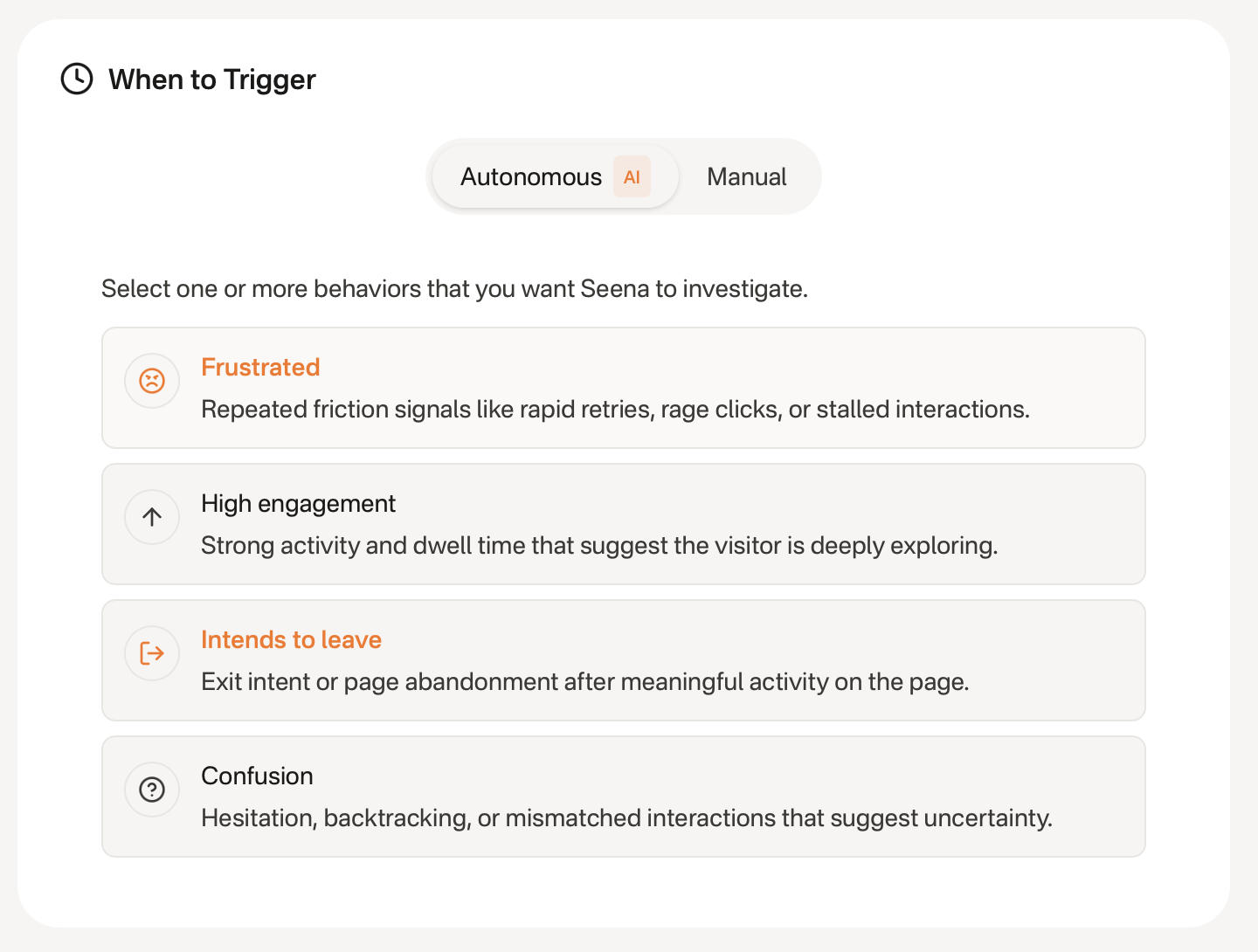
Asks in context, not three weeks later. When behavior raises a question worth asking, Seena's interviewer gets to work. Behavior and answer get bound together at the moment of capture — not reconstructed afterward from memory and field notes.
Briefs you with the answer, not the assignment. Every morning: what users did, where patterns formed, what Seena heard when it asked, and which evidence is worth reviewing. Listen on your commute. Walk in already oriented.
Shows its work. Every claim Seena makes is traceable to the moment it came from — the session, the click, the sentence. Transparency isn't a feature here, it's the contract. The Librarian, our in-dashboard research collaborator, lets you ask any question of your workspace and get an answer rooted in evidence you can replay. It can also answer questions about how to use Seena itself, so the product becomes a guide to its own research system.
Who Seena is for.
Built for product teams, with PMs as the spearhead.
But the deeper commitment is wider. Seena is for the people who don't have a research org down the hall. The solo founder who can't afford a dedicated UX researcher. The designer who wants to close the loop between behavior and intent. The PM whose research request lives in a six-week queue.
And for the experts — UX researchers, design researchers, the people who do this for a living — Seena is a multiplier. Less time scaffolding evidence. More time on the judgment that only a human can do well.
If you can do research today, Seena lets you cover ten times more ground. If you can't, Seena lets you start.
A note from the founder.
I did my PhD in human-computer interaction, studying the methodologies for understanding how people use technology and what they're really trying to do with it. My thesis focused on using machine learning to analyze large-scale qualitative data.
The rest of my career has been inside companies — Apple, Amazon — and alongside founders building startups, watching the same pattern repeat at every scale.
User understanding is the first thing to get cut. Not because anyone thinks it doesn't matter. Because research velocity becomes the bottleneck, and the team has to ship.
Seena Labs is my commitment to changing that. For everyone — not just the teams with a research org down the hall.
—Dr. Ax Ali, Founder
What's next.
Release 0 is the foundation: behavioral analytics, in-context AI interviews, daily audio briefings, and the Librarian.
Coming next: deeper integrations with the tools product teams already live in, a research graph that connects insights across studies and time, and the agent-governance work that keeps Seena from ever feeling like an interruption to your users.
We're early. We're listening.
FAQ
How is this different from analytics? Seena includes analytics, but it does not stop at charts. It tracks behavioral sessions, detects patterns, selects the moments worth investigating, and connects what happened to why it happened when users give us their words.
How is this different from running an LLM over old transcripts? Seena isn't a wrapper over yesterday's artifacts. Evidence is collected in context — while the user is doing the thing you want to understand. Behavior and conversation are bound at the moment of capture, not reconciled six weeks later. Seena uses a proprietary, multi-step, multimodal analysis approach backed by the science of human-computer interaction to analyze the data. It does not rely solely on LLMs to make sense of the data because LLMs look for speech patterns, not human behavior and intent.
Does this replace UX researchers? No. It makes research possible for teams that can't afford one, and it multiplies what experts can cover. The job shifts from manual evidence scaffolding to higher-order judgment — which is the part that always needed a human.
Will Seena annoy users? Every Seena agent is governed by rules for when, how often, and how it can engage. The defaults are conservative, the controls are yours, and the interviewer is designed to feel like a thoughtful conversation rather than an interruption. See Agent governance.
How hard is installation? A single line of script. Most teams are live in under a minute. Start with Install Seena.
What's a daily briefing? A one-to-three-minute audio summary of what your users did and said in the last twenty-four hours, with the insights and links to evidence inline. Walk in already oriented. Read What is a briefing.
What's the Librarian? Your in-dashboard research collaborator. Ask any question of your workspace and get an answer with every claim traceable to its source. Read The Librarian.
Where can I learn more? For more frequently asked questions, head over to the FAQ or read the guides.